Money Matters Episode 347-Brain Fog, Weight Gain, and Mood Changes? It Could Be Perimenopause W/ Dr. Susan Hardwick-Smith

Brain fog, mood changes, disrupted sleep, weight gain, and changes in sexual wellness can make perimenopause feel confusing and isolating. Christopher Hensley speaks with Dr. Susan Hardwick-Smith—OB-GYN, certified menopause practitioner, author, and founder of Complete Midlife Wellness Center—about how changing hormone levels may affect the brain and body.
Dr. Hardwick-Smith discusses the phases of perimenopause and menopause, common questions surrounding hormone therapy, the importance of finding properly trained care, and practical ways women can support muscle, metabolism, and long-term health. The conversation also draws an important connection between health-span planning and financial planning: informed decisions made earlier can compound over time.
This episode is educational and is not personal medical advice. Consult a qualified healthcare professional about individual symptoms and treatment decisions.

 Spotify
 Pandora
 Apple Podcasts
 RSS Feed
 Brain fog, weight gain, mood changes, disrupted sleep, and a fading sense of feeling like yourself can all become part of the perimenopause experience. But why do these changes happen—and why are so many women still struggling to find informed care?
In Episode 347 of Money Matters, Christopher Hensley, RICP, CES, speaks with Dr. Susan Hardwick-Smith, a nationally recognized OB-GYN, certified menopause practitioner, author, and founder of Complete Midlife Wellness Center.
Dr. Hardwick-Smith explains the hormonal transition from the fertile years through perimenopause and menopause, including how changing estradiol, progesterone, and testosterone levels may affect the brain, sleep, metabolism, muscle, mood, and sexual wellness. She also discusses the continuing debate around menopausal hormone therapy, why specialized menopause training matters, and how women can begin planning for a longer health span.
In this conversation
- What perimenopause is and why symptoms vary
- Brain fog, mood, memory, and sleep changes
- Metabolism, insulin resistance, and midlife muscle loss
- Sexual wellness and the role hormones may play
- Questions surrounding the 2002 Women's Health Initiative reporting
- How to find a qualified menopause practitioner
- Practical steps women can begin taking in their 40s and 50s
Chapters
00:00 Compliance disclosures and show introduction
00:38 Cold open: hormones and brain function
01:04 Welcome and episode introduction
02:46 The three hormonal phases of a woman's life
04:35 How perimenopause may affect the brain
06:14 Why symptoms vary from woman to woman
08:19 Hormone therapy and the 2002 WHI debate
13:03 Metabolism, muscle loss, and midlife weight changes
15:57 Sexual wellness, desire, and testosterone
19:13 Who may benefit from treatment and finding informed care
21:29 Advocating for yourself in the medical system
23:17 Why Complete Midlife Wellness Center was created
24:46 Create Her and planning for a longer health span
27:11 Three practical steps for women in midlife
Resources mentioned
- Complete Midlife Wellness Center
- The Menopause Society practitioner directory
- Create Her: Aging Into the Healthiest Version of Yourself by Dr. Susan Hardwick-Smith — book details and preorder information (publishes February 2, 2027)
Subscribe to Money Matters for practical conversations about the financial, physical, and personal decisions that shape a well-planned life.
This episode is for educational purposes and is not personal medical advice. Treatment decisions should be made with a qualified healthcare professional. Medical interpretations and treatment perspectives expressed in the conversation belong to the guest.
EP347 - Final Mix
[00:00:00]
Susan: Understanding that our brains are not being fed the materials that they need to operate perfectly- if you had a Ferrari or your favorite supercar, you would not drive it without putting oil in it. You would check it every weekend, I imagine.
Susan: When we're in perimenopause, we don't have enough oil in our brain, and that's so simplistic. But if we can imagine it that way, the machine can't work, properly or function optimally without these hormones being present,
Christopher Hensley RICP, CES: Good morning. You're listening to Money Matters. In a recent episode, we explored how perimenopause can affect relationships, why so many men misunderstand what their partners are experiencing, and how those changes can create distance or conflict, and what couples can do to communicate better. But that conversation naturally leads to a bigger question: What is actually happening inside a woman's body during this stage of life? Today, we're going deeper into the physiology of perimenopause and midlife with Dr. Susan Hardwick Smith, a [00:01:00] nationally recognized ob-gyn, certified menopause practitioner, author, and founder of Complete Midlife Wellness Center. Dr. Susan has spent decades helping women navigate hormone changes, sexual wellness, weight, sleep, mood, and healthy aging. So today, we're gonna connect that relationship conversation to the biology behind it and talk about what women can do to feel better, protect their long-term health, and move into midlife with more clarity and confidence. Thank you so much for joining us
Susan: It's a pleasure. Glad to be here
Christopher Hensley RICP, CES: Now I mentioned we did have a show recently, with, an author who had written a book from a men's perspective right? I think he's one of the first going down that road as far as, what us guys need to know about this. And so we talked about relationships, and so this is a nice, companion a follow-up on that episode.
Christopher Hensley RICP, CES: I sure appreciate you being on the show. I know you're here in Houston as
Susan: That's right
Christopher Hensley RICP, CES: I love it. Well, let's dive right into it. On that show we [00:02:00] focused about how perimenopause, affects relationships. What's the most important physiological change partners need to understand?
Susan: Well, first I think it might help to just explain what perimenopause is and what's happening with our hormones. So just quickly, I divide it into three sections, which is very simplistic, but just for your listeners. If you think about the time that women are younger and fertile, say, starting at age 12 up until, let's just say, 35 to 40, and I'm using that very broadly because there's so much variation in the age in which this happens to us.
Susan: During that time, for most women, our hormones are pretty regular. We're having a period every month. Our hormones are going up and down in a nice predictable manner. And for the most part, everything's pretty okay. Now, certainly some women struggle with their cycles even when they're younger, but, talking about the average patient, hormones are pretty manageable during that time for most women.
Susan: So the hormones we're talking about that come from the ovaries are [00:03:00] estradiol, that's the primary type of estrogen, progesterone, and testosterone. And so all of those hormones are being produced in varying amounts, so they go up and down with our cycle and generally manageable. Now, jump ahead to menopause.
Susan: That's when all of those hormones stop being produced, and those levels can be very close to zero. Everybody knows how to diagnose that. We stop having periods, and that's a very abrupt hormone shift. The in between those two is what we call perimenopause. So there's not a lab to diagnose it. It's a time of life in between the young and fertile and the end of hormone production where things are just going a bit wonky.
Susan: Estradiol is very up and down. Lots of highs and lows. Progesterone and testosterone are just slowly declining. So with that in mind, each of those hormone changes has different effects, on our women's brain, on our weight, on our sleep, our mood, our memory. Every part of our body is affected. So, you know, as your speaker mentioned last week, it primarily shows up, this middle [00:04:00] phase, as a cognitive issue.
Susan: So most patients recognize it with mood swings, changes in memory, snippiness, tiredness, typically something to do with our brain because these hormones are incredibly important for our neurologic function. So while those hormone changes are going on from our ovaries, the main place that we first notice it in perimenopause is in our brain, the same way that your speaker mentioned last time.
Susan: Understanding that our brains are not being fed the materials that they need to operate perfectly- if you had a Ferrari or your favorite supercar, you would not drive it without putting oil in it. You would check it every weekend, I imagine.
Susan: When we're in perimenopause, we don't have enough oil in our brain, and that's so simplistic. But if we can imagine it that way, the machine can't work, properly or function optimally without these hormones being present, and they're coming in and out and in and out. So this is why women sometimes don't feel great, and it's, it's very understandable, when, [00:05:00] when you, when you imagine those hormones in that way
Christopher Hensley RICP, CES: I love it. I think that's a great explanation. Although I, I'm the exception here. You're talking to one of the most frugal people on the planet, so a Ferrari... Well, let's see, what can we use? Maybe a Honda or something.
Susan: Well, Chris,
Christopher Hensley RICP, CES: get
Susan: if you had a Ferrari, you would be putting oil in
Christopher Hensley RICP, CES: Yes.
Susan: frugal. So there you go
Christopher Hensley RICP, CES: Yes. A- absolutely. I would keep it going for sure. Well, I love that. I think that's a great explanation. What's actually happening in a woman's body during perimenopause, and why can the experience vary so dramatically from one woman to another?
Susan: Well, I mentioned the change in those three hormones. That's what's happening. So we're no longer releasing an egg every month. Now, there are exceptions. Some women didn't do that even when they were younger. But let's just say the average patient releases an egg every month. If she doesn't get pregnant, she has a period, and on it goes.
Susan: So when we get into our 40s, often, again, age is very variable, we stop ovulating regularly. So the eggs are [00:06:00] no longer getting that magical signal to do their thing on time every month, so ovulation becomes irregular. The hormones that are produced by the ovary start becoming very up and down and irregular.
Susan: And, you know, as I mentioned, that primarily affects our brain. Now I do wanna mention, this is not something that women have to just put up with. So a lot of the conversation about perimenopause and menopause is in the context of, oh yes, all these terrible things will happen. Your wife's gonna become horrible, and let's figure out how to handle that.
Susan: Well, that's an option, but these days we have very, very safe and very good ways to treat patients so they don't have to just feel terrible and be moody and all of the things I just mentioned. We can really make those symptoms go away. So yes, untreated patients have those symptoms, but treated patients can really just get, you know, slide through it with very few symptoms, if any.
Susan: So my main message would be get help. You don't have to suffer. [00:07:00] The suffering's optional. But yes, that's what we feel if we're not treated. I'm a big proponent of treating it. We don't get any extra points for suffering, and like you said, as your speaker mentioned last week, it affects the whole family.
Susan: I mean, this is a very... And work and every part of our life. So it's not just the patient. It really extends to everybody that she's, connected with
Christopher Hensley RICP, CES: Susan, I know, um, uh, uh, some people are hearing what you're saying and they're saying, "That's great. There's some treatment that can be done." But they've also heard, myths or things in the past that studies that are maybe not, well-founded. Can you speak to a little bit about some of the stuff that people heard prior to the idea that, hey, this is something that can, we can treat?
Susan: Yeah, this is a very long story, and I'll just make it very short, 'cause it could take a couple hours of conversation. We're coming out of a couple of decades of complete misinformation about hormone replacement therapy. We now call it menopausal hormone therapy. But using hormones to treat symptoms of menopause and also help prolong [00:08:00] life because, these hormones do reduce the risk of the most important chronic diseases that kill us.
Susan: Back in 2002, which was a long time ago, almost 25 years now, a study came out that misreported some very important data and led to decades of people being scared that taking estrogen in particular increases the risk of breast cancer, in particular heart disease and stroke.
Susan: And so those things have just remained in the community like things do. They're not true. Even the authors of that study, everybody who understands anything about science recognizes that that was not reported accurately and was based on a very unfortunate press release that came out in 2002, and we're still struggling with the ramifications of that.
Susan: But actually, even that study, it was a very good study, biggest study ever done in this country, paid for by the NIH. It cost a billion dollars with a B, showed that estrogen does not cause breast cancer. In fact, the group who took estrogen had a reduced instance of breast cancer, and also doesn't cause heart disease or stroke either, unless you take it by mouth.
Susan: So kind of problem [00:09:00] solved. Doesn't cause any of those things. On the good side, it reduces the risk of heart disease by 40%, osteoporosis injuries, neurologic decline, sexual dysfunction, diabetes, weight gain, every kind of thing. So nowadays, we're really thinking of, taking bioidentical hormone replacement as a health span adjuvant.
Susan: It makes us live longer in a healthier state. It does not cause any other problems. So we're just coming out of that age of misinformation
Christopher Hensley RICP, CES: Thank you for sharing that. For people who've heard that old story, there is new information out, and Susan, this is, somebody who works in this space every single day, and so she's seeing that play out in real life. Thank you for sharing that. Why can hormonal changes affect mood, anxiety, sleep, concentration, and even a woman's sense of identity?
Susan: Well, primarily because these hormones are present in every cell in our body and very highly concentrated in the brain. So back to the Ferrari analogy and just [00:10:00] say a human brain is about a million times more complex than a Ferrari, but these critical hormones that help our brain to function optimally simply are not present or are being taken away in a very, up-and-down rollercoaster manner.
Susan: And so it's very, very difficult for a human being to maintain emotional equanimity when these hormones are being pushed in and out of our brains at unpredictable times. And so most patients, and I certainly was one, really struggled with, balance and natural things like sleeping when it's dark. We'd be wide awake in the middle of the night, kind of like when you have jet lag.
Susan: Remembering things, I can't remember the name of the word because the message to go get that piece of, that file in the back of our brain, it's kind of like a little old lady librarian. Instead of zipping down there, it takes longer to recall. And these are physiologic things that happen in the brain.
Susan: Studies done on the brain of women who are going through these hormone changes actually show that parts of the brain physically change. There are anatomic changes in the brain. So this isn't a, hysterical [00:11:00] situation where the patient just needs to pull herself together or go to a psychologist or something.
Susan: Brain is physically changing, and now all of that is reversible when the hormones are restored. But it's a very real, anatomic pathology in the brain. And I use the word pathology lightly 'cause this is a natural transition. But, you know, we were only made to live about 50 years, and a lot of things that are natural we treat, like cancer , for example, infection
Susan: So treating things that are natural is a really good idea. That's, why we live in this wonderful country. Um-
Christopher Hensley RICP, CES: I love, I, I, I love the idea that when you mention we were only really meant to live about 50. We have the same problem as financial advisors. As longevity goes up and we get closer to 100, we have a big math problem to solve. Same thing as we live longer, we're now in a unique area where we've got new things that are available for tools and trying to get that problem to stretch longer. You shared something with us. You talked about how, jet lag is one way of kinda [00:12:00] describing how this might feel. You talked about the little old lady librarian when your brain's trying to access that information and coming back with it a little bit slower. But I think those are great ways to illustrate this point that you're making there.
Christopher Hensley RICP, CES: I'd like to pivot just a moment, and talk about why, weight, metabolism, and body composition often change in midlife even when a woman has significantly changed her habits?
Susan: Metabolism does change as we get older, and so gaining weight and redistributing it so that we get more fat around the middle and lose muscle, that's something that happens actually to both men and women.
Susan: So you look at the average dad bod as you get older, fat around the middle.
Christopher Hensley RICP, CES: I will testify to
Susan: Right. So that's also associated with age and hormone decline for men, but around midlife, women get very, very efficient at storing fat. We become resistant to the hormone insulin, so insulin tends to rise, and that's a fat-storing hormone.
Susan: So our body is on a mission to get glucose and turn it into fat. And so we get very, very [00:13:00] good at that, storing fat around the middle. Now, I imagine if we were a caveman, that would have been a really good adaptation, just like bears store fat for the hibernation. Some of this is just old evolutionary biology, but we get more, resistant to insulin, as I mentioned, so much better at fat-storing, and what we used to do doesn't always work anymore.
Susan: At the same time, we are losing muscle. That's a natural trajectory, so it's critical that we change that. If we're going to live longer, as you mentioned, regarding financial planning, if our plan now is to live to be 90 or 100, we can't just allow that natural loss of muscle and gain of fat to happen, or we won't make it to there.
Susan: We'll get very sick and die from common diseases like heart disease, diabetes-related complications, or at least just be miserable and immobile, and nobody wants that. So we can counter all of that by shifting our nutrition, as do men have to do the same, really cutting down on sugar, getting rid of processed foods, eating a very protein-forward nutrition plan, and lifting weights.
Susan: So lifting weight for women in particular is something [00:14:00] that's quite new, but it's critical. It's the number one thing we need to do. So muscle is the organ of longevity. We can't, can't live without it.
Susan: And to be... I just wanna add the hopeful point that it's not, a given scenario that this will just continue to happen. You can address it. I've done so myself. I'm an athlete. I have more muscle mass than I've ever had now in my 50s. But yeah, it took some work. I had to change some things around. So eat lots of protein, lift weights, and you'll be able to redo that natural change that's happening just as a function of getting older.
Susan: And I give the same advice to men, as I do see men as well, husbands of my patients women are different for sure, but men experience a lot of the same things. So some of it is appropriate for everybody
Christopher Hensley RICP, CES: It what pops into my head when you share this with us is just mobility in general as we age. A lot of at the end of life, injuries that we have have to do with balance or stability and the impact of doing strength training and bringing muscle into those [00:15:00] areas to support your joints, to support the muscle group, huge game changer if we're trying to live longer.
Christopher Hensley RICP, CES: I love that. Very good information to share with listeners today. Now, your work has focused extensively on sexual wellness. What do women and their partners most often misunderstand about changes in desire, comfort, and intimacy during midlife?
Susan: For women, sexual function's very complex. Sexual function's complex for everyone, but for women there's so many things that can affect our sexual desire. So saying that it's just hormones would absolutely not be accurate.
Susan: There's a lot of things going on for many of us when we're in our 40s, for example. We might have kids that are getting to college age or having their own issues. We might have parents that are getting sick and dying. We might be in a job that's reaching an end point or a transition. We might be in a long relationship that's struggling.
Susan: There's a lot of things happening at the same time. So if our sexual desire changes, it could be any of those things. And then we [00:16:00] already talked about not sleeping well, we're just tired, and then we don't like our body 'cause we're getting fat, so it's like mm-mm-mm, stacking up all the reasons why I might not wanna have sex.
Susan: Now, certainly all of those can individually be addressed, and we want to look at it as a holistic picture. But I will tell you, one of the things that is in that milieu is a drop in testosterone. So testosterone for women has been studied in multiple randomized controlled trials. Those are the ones that we think are valid, where placebo and, medicine are given to a group of patients.
Susan: Testosterone in the appropriate dose for women helps sex drive undeniably, so that's a very helpful intervention as long as we're addressing all the other things, too. It won't work if you are exhausted and you're really mad at your partner. So we wanna work on those things as well. But, testosterone's very helpful.
Susan: Now, also we can get vaginal dryness, and it can make intercourse painful, so we wanna address that as well. That's a low estrogen symptom. So for women, we need a healthy mind to wanna have sex, [00:17:00] and we need a healthy vagina to make it comfortable. And another point I'll mention is, men have ED, and that's very well discussed.
Susan: Women have a version of that, too, where the blood flow simply goes away in the middle, and whoop, the feeling's gone. So blood flow to the genital area is really important and is enhanced by hormones. So there's so many things we can do to help. I encourage couples not to feel stuck, and I hear this a lot where they're just like, "Eh, you know, this is the way it is.
Susan: I heard, you know, none of my friends are having sex either. I guess we're just getting old. We're just gonna sleep in separate rooms." Unless that's something that you want to do, and I honor everybody's, different relationship structure, but very rarely have I found that that's really something that people want to do.
Susan: Most of the time there's a real genuine desire to have that connection back and, we can help. We can help to get it back. I am certainly not giving up. I don't think, for myself, and my patients mostly want to continue being sexually active until the day they die. And I hope that's, possible.
Susan: It certainly is [00:18:00] possible
Christopher Hensley RICP, CES: And you mentioned there are many different factors as far as relationship quality and all kinds of different things, but when we get to the physiology of it and the things that you shared, definitely, an important thing for couples to be looking at, not settling with a, "Hey, this is what's generally happening with our age group," that there are other options there, and you're seeing that day to day in your practice as you're healing people with this treatment. Let's talk a little bit about, what do you wish more women understood about hormone therapy, including who may benefit and what questions they should ask their doctor?
Susan: Every woman is gonna go through menopause. It's like, death and taxes, right? You're not gonna avoid it. So every woman is going to experience this, very abrupt drop in hormones, and with very few exceptions, she's gonna experience some significant symptoms when that happens.
Susan: So knowing that we can't escape it, I think it's really important that women, learn about it. Many women, including doctors, were not really taught anything about this. So [00:19:00] becoming educated so that we understand what's happening in our body and know what options we have to mitigate those symptoms.
Susan: If you're a woman in your 40s, I highly recommend seeing a menopause specialist. I'm part of the organization called, The Menopause Society, so if you look on their website, which is menopause.org, you can get a list of physicians who are trained in menopause. Because most average OBGYNs are not at all trained.
Susan: Not to accept just being brushed off if you ask your doctor, see the doctor and they're like, "Oh, you're fine," or, "You're too young for that," or other kind of, dismissing sentences. We know when something's not right.
Susan: Listen to your body. Make sure you find someone who will listen to you and really look into what's going on and offer you that full array of treatment options. And to remember that the science, this is not my opinion, this is what science has supported for about 10 years, that menopausal hormone therapy is not only safe, but is beneficial to our health.
Susan: We live longer if we take it. So we're flipping that around. We've gotta get out of the old, You know, I, I tell my patients they used to think [00:20:00] the world was flat. I mean, couple thousand years ago, it sure looks flat. It's not, right? And also, smoking's not good for you, and, the suntan beds are not good for you either.
Christopher Hensley RICP, CES: Go and figure. It took us that long to
Susan: That's right. So certain things that we thought were fine are not, and vice versa. So we just gotta, embrace the science, it's safe, move forward, and, consider that as an option if you don't feel good. No extra points for suffering
Christopher Hensley RICP, CES: I love that. You shared some resources with us, so if you're driving right now, don't worry, those are gonna be listed in the podcast notes as well, the website to reach out to get more information. You mentioned this experience of women going to their maybe primary doctor, telling them, "Here's how I'm feeling," and maybe that doctor hadn't had any training or a little bit of training on this subject, and so they get pushed away.
Christopher Hensley RICP, CES: How disheartening could
Susan: Mm-hmm.
Christopher Hensley RICP, CES: be if you went out on a limb and you shared this with a doctor and they tell you, "Hey, it's not a thing," or, "We're not gonna look at it"? And you're [00:21:00] encouraging people, listen to yourself when you feel those things. Keep going. Keep asking. Ask and you shall receive. So this is very, very good information for people who wanna advocate for their own health, and really get help there. You built a ma- Yeah.
Susan: Well, I will say, Chris, enhancing on what you said, it's so important. I totally agree with you. If a woman, oftentimes, let's just say, there's still a little bit of a paternalistic setup, not in my office, but when you go to see the doctor. You've got this guy wearing a white coat sitting behind a desk, and it's very much a I'm going to tell you what to do situation.
Susan: So challenging that and saying, um, you know, "Hey, I've got a question," or, "Do you mind looking into this?" It's very difficult and, and granted also, you're probably being given 15 minutes. So the system is not set up, to give you a lot of time or to have somebody listen. So if you run into somebody who's still operating from that very paternalistic model, I would just give yourself permission to find somebody else.
Susan: Maybe he delivered your babies. Maybe he took care of your whole family and your mom. Great. He did a great job. Now it's time to move on to somebody who really understands [00:22:00] this part of life, and it might not be your own OBGYN 'cause as you mentioned, we got absolutely no, if they're anything like my age, I'm in my 50s, we got no education about menopause, zero.
Susan: And this does not take 15 minutes. My visits take 90 minutes. Takes an hour and a half just to get through the first series of questions. So you deserve to be listened to. And, you know, if somebody tells you you're fine, you know you're not fine if you're not. So we don't wanna be told there's something wrong with you or you're just crazy or all these things.
Susan: It's very, very, hard for patients to put themselves in that position. It's a lot to ask of someone to do that when we're very vulnerable, and it's a very, vulnerable topic like you said.
Christopher Hensley RICP, CES: Super important point there. You built a major practice and then created Complete Midlife Wellness Center. What gap in women's healthcare were you trying to solve?
Susan: So our mission statement actually addresses this. We saw a gap in women's healthcare and decided to fill it. The gap really was, in the areas that we're talking [00:23:00] about. Giving patients time, having experts, which I was not. Like I said, I wasn't taught anything. In 2020, I got a whole lot of education and have made it my life's work since then.
Susan: So for six years, I've been focusing only on this topic and spending hours on it a day, staying educated and, making sure that our providers have all the right information, working with groups like the Menopause Society to help change, recommendations so that, other doctors can be educated.
Susan: So there's a real push towards that. But the gap is still there. I mean, there's a few practices that focus on menopause, but, Complete Midlife Wellness Center in Houston has three offices, and that's all we do. We treat women who are either beginning or even after the menopause transition. Typically, our patients are 35 to 65 or older, and we don't deliver babies or anything else, so that's all we do.
Susan: So that still is a gap, but we're doing our part to fill it. And it's been a wonderful experience, so really enjoying learning more about this, very [00:24:00] untapped area in medicine. We still know tiny bit about it. Learning more and more all the time. So much research still needs to be done.
Christopher Hensley RICP, CES: So much information there, so much, resources for people. Now, the book, this is something that I wanted to start with, but I saved the best for last here. So you are working on a second book now. This book is called Create Her: Aging Into the Healthiest Version of Yourself. Is that
Susan: Yeah, it's finished, and has a publication date of February 2nd. But we do have a pre-order link already that we can, share. So C- Create Her really is, for the audience of women who are aging, which is all of us, women in midlife who are anticipating what their second half of life is going to be like, and really taking responsibility to make decisions that are going to create the best elder version of ourselves.
Susan: So when we imagine that 90-year-old that we wanna be, what do I have to do now in order to get there? Like some of the things you mentioned, like weight training, eating protein, taking hormones probably, taking care [00:25:00] of our health in all of those ways, our relationships. Now, it doesn't just happen. It doesn't happen on its own.
Susan: It happens because of decisions we make now. And so it's a very hopeful book. You know, everybody could become the best elder version of themselves, but I'm so sad when I meet someone who's 75 and she hasn't made those decisions, and now, really it's gonna be very difficult to reach that goal.
Susan: Not unlike your financial planning patients. If they're 75 and they haven't saved anything, you're doing the best you can with what you're given, but you're not gonna be able to get to what you really wanted. So we've gotta start early. And it is very much like saving money.
Susan: We're saving muscle, we're saving bone, we're saving health from deteriorating in a way that we can't retrieve. So quite similar actually to what you do.
Christopher Hensley RICP, CES: I love it. Now I had somebody talk about it in this way. This was a woman who was an influencer. She was in her 70s and she was still putting out videos on YouTube and she called it first, second, and third act. And [00:26:00] I love that because it's the idea of entering into your second half of life or your third of life and entering into a brand new space.
Christopher Hensley RICP, CES: This book, Create Her Aging in the Healthiest Version of Yourself, sounds like a guidebook to help people through that second or third act of their life so we don't have to do it alone. What a great, resource for us there. We are getting right towards the end of the show here. What are the three most important actions a woman in her 40s and 50s can take now to improve both how she feels today and her long-term health span?
Susan: Well, the first one, if she hasn't done so, is find a partner, health physician or provider who's gonna be a partner with you through this transition who can help to educate and support you. So somebody like my providers or myself or whomever you can find who's gonna walk with you through this, 'cause it's hard to do alone.
Susan: Get some blood work done. I encourage everyone at around age 40 to do a baseline, full series of blood work to see where you're starting. And then make a plan [00:27:00] in each of the buckets of health. The obvious things like nutrition, exercise, sleep, emotional wellness, and then fun and play, and dividing all of the aspects of your life and really looking at each one so that you can optimize each to get to where you want to be when you're older.
Susan: Now, that might have been more than three things, but I think if we approached it that way, and not from a position of kind of, ugh, I gotta do all these things, like oh my gosh, what a long list she just gave me. From a joyful place because, hey, if I do these, I'm going to get good results. Imagine like when you invest well and you see that blossoming, it becomes something you want to do because you're seeing good results.
Susan: So I'm all about having fun and enjoying my life. I don't wanna do miserable things in order to live longer. These are things that are fun and enjoyable, make you feel good now, and also make you feel good as you're older, just like saving in a responsible way. Same, same idea
Christopher Hensley RICP, CES: What a great spot to stop here. Susan, just one [00:28:00] more quick question. For listeners who wanna find out more about you, how to contact you, how to get a copy of the book, where should they
Susan: So everything's on our main website, which is completemidlifewellnesscenter.com. So three locations in Houston. We also see patients virtually. We have 12 providers. Everything about the book and my YouTube and everything lives on that website. So, you can check it all out there
Christopher Hensley RICP, CES: We love it. Thank you so much for joining us this morning.
Susan: My pleasure. You too
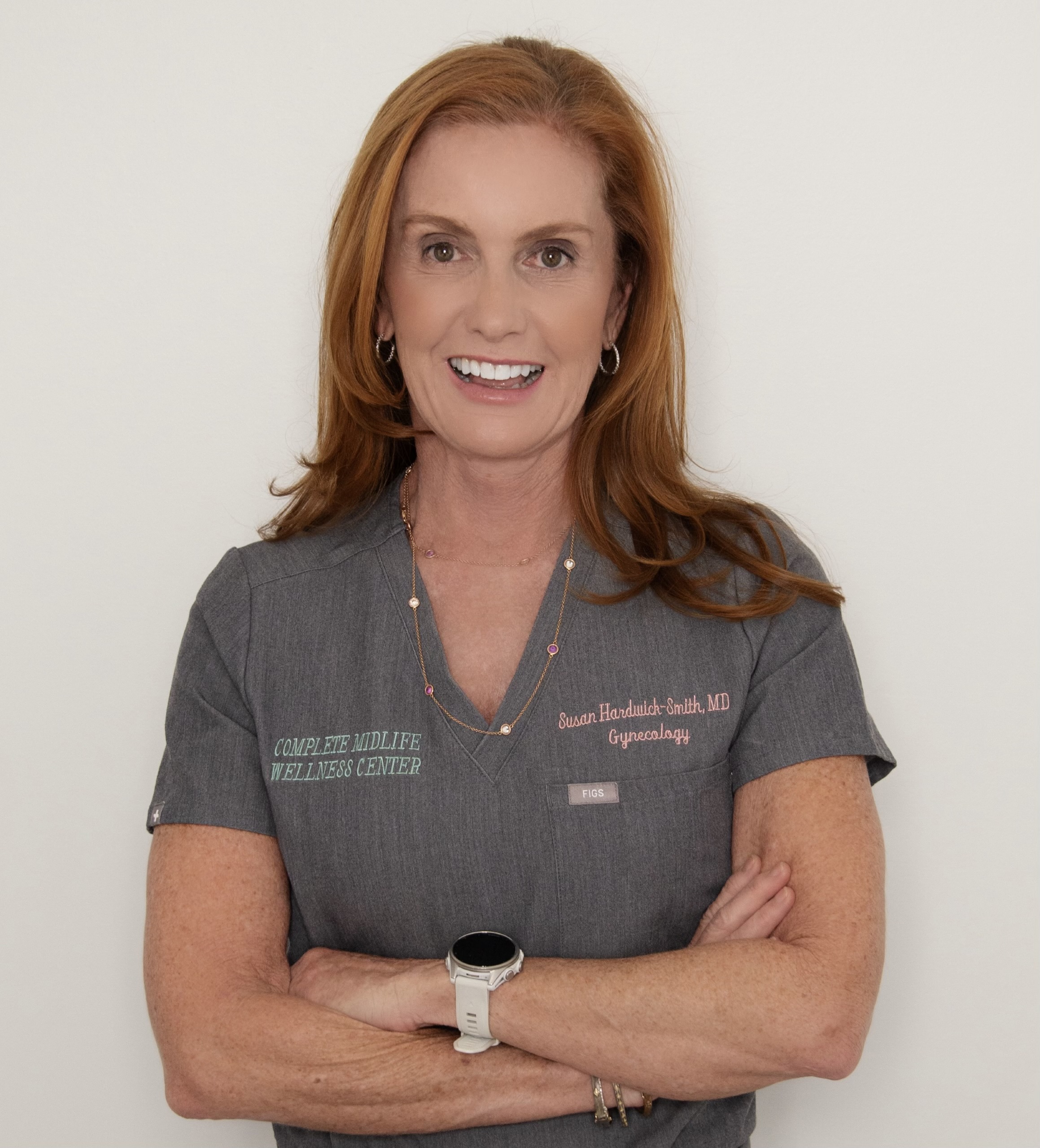
Board certified obgyn and certified menopause practitioner
https://completemidlifewellnesscenter.com/wp-content/uploads/2026/02/New-Bio-July-2025-SHS.pdf
All links are here:
Join Me on My Social Networks
https://YouTube.com/@drsusan
https://www.linkedin.com/in/drsusanhardwicksmith
https://x.com/drsusanofficial
https://www.instagram.com/drsusanofficial/
https://www.facebook.com/drsusanofficial/